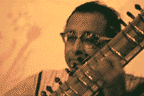
 Photos: Ira Landgarten
Photos: Ira Landgarten
In the early 70s, while living in Amsterdam, I became infatuated
with Indian classical music. Amsterdam was a true cultural crossroad,
and the interest in the East was high. Many prominent Indian artists
performed there during European tours, and there were even a few
resident musicians like sarangi player Ustad Munir Khan and his
tabla player son, Zamir Ahmed Khan who had developed a small,
avid following. My particular focus of interest was sitar, and
I voraciously tried to collect all and any recordings I could,
mostly of Pandit Ravi Shankar and Ustad Vilayat Khan, which were
available in abundance. One fateful day, a Dutch fellow aficionado,
knowing of my obsession, asked if I was familiar with Pandit Nikhil
Banerjee. Since I wasn't, he loaned me a well-worn Gramophone
Company of India LP of Mr. Banerjee. That record (Lalit, Sindhu
Bhairavi, Puriya Kalyan EASD 1355) immediately became my favorite
and I searched high and low for more Banerjee; alas, very few
recordings turned up.
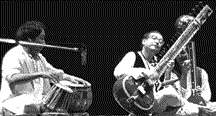
Faiyaz Khan and Nikhil Banerjee at the Royal
Opera, Brussels a few days before the De Kosmos concert. Zamir
Ahmed Khan is Faiyaz Khan's nephew.
Then in the autumn of 1972, I got word that Mr. Banerjee would
be in Europe and that there was a gap in his touring schedule
between Belgium and Germany. I was convinced that he must come
to Amsterdam. I immediately approached some friends at De Kosmos,
a large old wooden church near the harbor which had been turned
into a popular center for 'alternative activities.' De Kosmos
was in fact a mecca for world travellers, hippies and anyone interested
in psychedelia, Eastern mysticism or the occult.
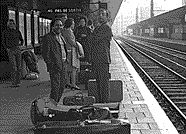
Faiyaz Khan and Nikhil Banerjee at the Brussels
train station en route to Amsterdam.
So with the go-ahead from De Kosmos, I trained down to Brussels
to meet Mr. Banerjee and escort him back to Amsterdam. He was
performing at the Royal Opera and I arrived late. No one stopped
me or asked for my ticket. As in a dream, I entered the dark hall
- ticketless!-just as he began his spell-binding alap, and sat
motionless in the aisle until the intermission. I was enthralled
by what I heard! After the concert, I introduced myself and we
arranged to meet the next morning for our train ride to Amsterdam.
We were forced to stand the entire journey, and I was amazed at
how unperturbed he was about the lack of seats. He was from Calcutta,
after all, and with his gentle, unassuming, philosophical nature
he just took it in stride! Once we arrived, I delivered him to
a small, cozy hotel near De Kosmos.
There was a definite buzz of excited anticipation in the air as
Mr. Banerjee took the stage lit by an enormous light-show projection.
He began the performance with Manomanjari, a raga of his own design
which he magnificently rendered with a sense of joyous heroism
and virility. He concluded with a charmingly romantic rendition
of Sindhu Khamaj, 'raga-mala' fashion, sprinkled with tastes of
Hamir, Hindol, Hindoli and, finally, Hansadhwani. Fortunately,
Felix van Lamsweerde, from the Royal Tropen Museum, was able to
capture this remarkable music on tape and allowed Raga Records
to bring it to you. So enjoy! -- Ira Landgarten